Verification procedures of
the in situ constructed geometry of the permeable reactive barrier (PRB) are
important for high confidence in the quality control and quality assurance of
the constructed PRB. Difficulties in direct sampling of the iron PRBs have been
experienced at both shallow and moderate depth due to the inability to contain
the iron filings within the sampler tool. At significant depth and/or in
flowing ground conditions, direct inclined samplings of undisturbed iron PRBs
have been found to be extremely difficult. Under these conditions the ground in
front of the sampler flows into the outer protective casing when the sampler is
withdrawn and thus disturbs the ground for the next sampling interval. The next
sampling attempt then samples disturbed ground consisting of a mixture of
native soils and iron filings.
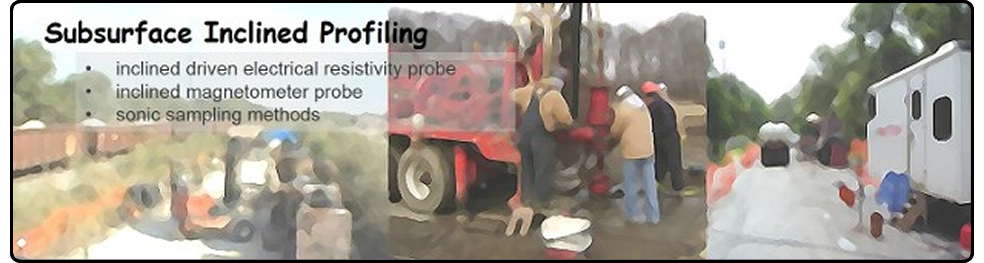
Such direct PRB sampling
difficulties have led to the utilization of an inclined direct push soil
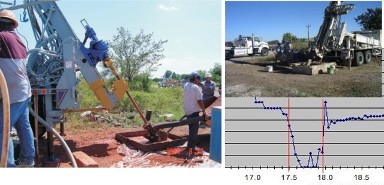
electrical conductivity/resistivity probe to determine indirectly the iron PRB
geometry. The electrical resistivity contrast between native soils and the iron
PRB are generally sufficient to clearly identify the iron PRB geometry. The
electrical conductivity probe is approximately 6" in length and 1.5"
in diameter. The probe contains four electrodes spaced approximately 1"
apart. The probe electrodes are excited by a low voltage current and soil
conductivity can be quantified by the instrument. When the probe penetrates an
iron PRB wall, a significant change in conductivity is recorded, thus providing
a measurement of its thickness.
An alternative method is to
incline drill through the PRB and install a temporary non-metallic casing across
the PRB intersection. A borehole magnetometer probe is then run in and logs the
thickness of the iron PRB directly. Since the magnetometer measures the
presence of the iron directly, then this method is considered superior to the
inclined electrical resistivity probe.







 +1 (770) 559-4429 info@geosierra.com